
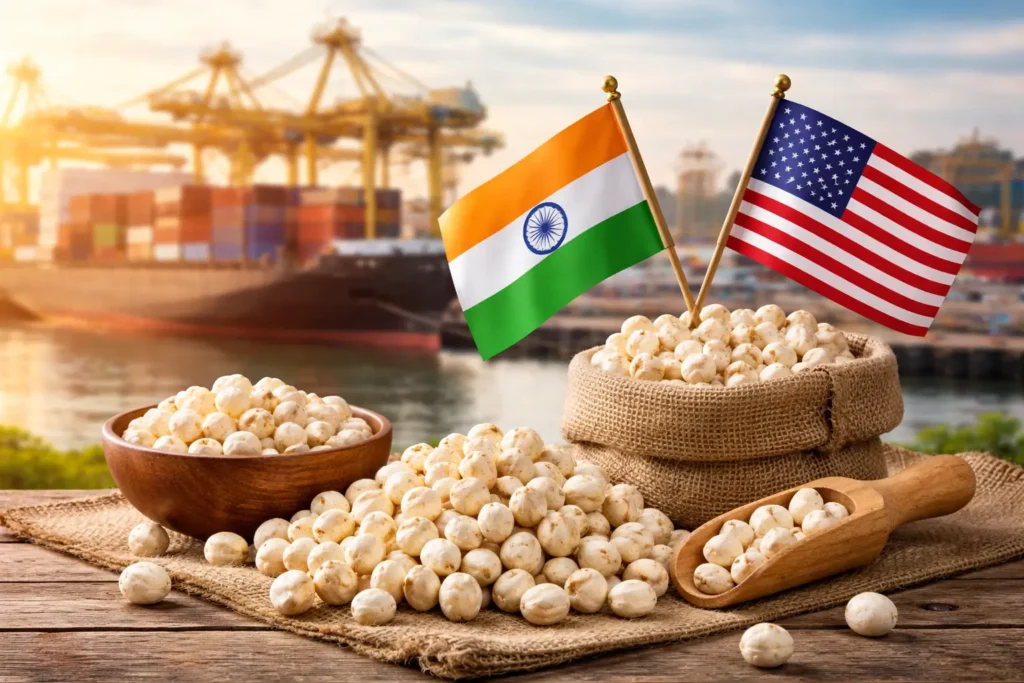
How to Source GI-Tagged Bihar Makhana — America’s Fastest-Growing Healthy Snack Ingredient
Fox nuts — also widely known as makhana, popped lotus seeds, or water lily seeds — have quietly become one of the most talked-about ingredients in America’s $50+ billion healthy snack market. Light, crunchy, high in protein, gluten-free, and plant-based, they check every box that today’s U.S. health food consumer is looking for.
India is the world’s dominant producer of fox nuts, supplying over 95% of global demand.
And within India, the Mithila region of Bihar stands apart as the undisputed source of the world’s finest export-grade makhana.
This guide is built for U.S. food importers, snack brands, natural food distributors, and private label buyers who want to understand the full picture: why India leads global supply, what makes Bihar makhana worth the premium, how to evaluate exporters, and what compliance steps are required for importing into the United States.
| Quick Facts
India produces over 95% of the world’s fox nuts. Bihar alone contributes approximately 80-85% of India’s total output. In 2023, Bihar makhana was awarded a Geographical Indication (GI) Tag — a globally recognized mark of authenticity comparable to Darjeeling Tea or Basmati Rice. U.S. imports of fox nuts have grown over 60% in the past three years. |
What Are Fox Nuts (lotus seeds)?
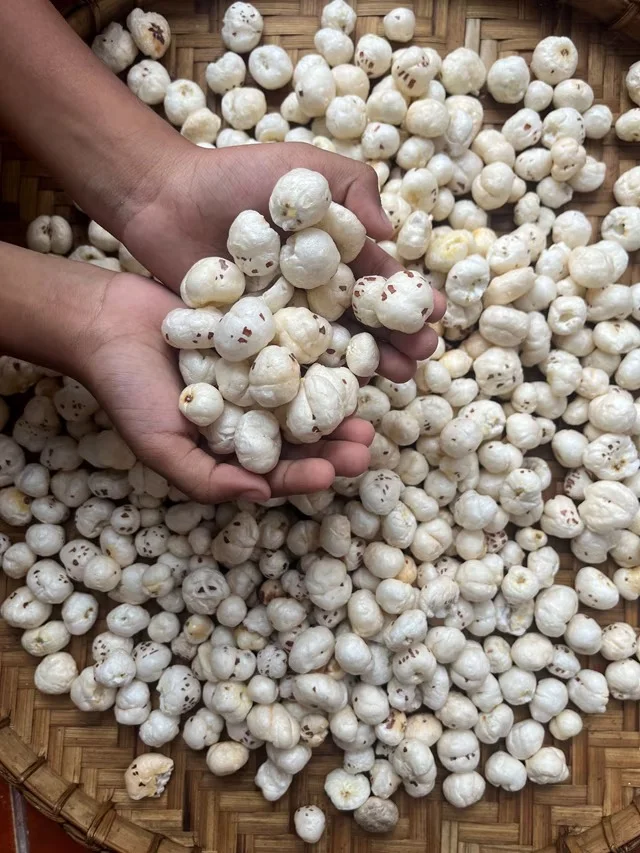
Fox nuts are the super food, edible, popped seeds of the Euryale ferox plant an aquatic crop grown in shallow freshwater ponds and wetlands.
Native to South Asia, the plant’s seeds are harvested, sun-dried, and then roasted at high heat, causing them to pop and expand into the light, airy snack food that has captivated U.S. health food consumers.
In India, they have been cultivated and consumed for centuries under the name makhana. In the United States, they appear under several names depending on the product format:
| Name Used | Context | Common Product Format |
| Fox Nuts | Health food retail, snack brands | Roasted, flavored snack pouches |
| Makhana | Indian grocery, specialty stores | Raw/roasted bulk packs |
| Popped Lotus Seeds | Premium wellness brands | Clean-label snack products |
| Water Lily Seeds | Natural food industry | Ingredient listing on packaging |
| Puffed Lotus Seeds | Food manufacturing | Ingredient for bars, cereals, mixes |
Regardless of the name used, they are the same product. The key for U.S. buyers is understanding that grading, processing method, and origin significantly affect quality and that not all makhana available on the market is equal.
Why India — and Specifically Bihar — Leads Global Supply
India’s dominance in fox nuts production is not a recent development. It is the result of centuries of traditional cultivation, a uniquely suited climate, and a farming ecosystem that cannot be easily replicated elsewhere.
The Bihar Advantage
The Mithila region of Bihar, in northeastern India, is recognized globally as the heartland of makhana production. Its network of natural floodplains, seasonal ponds, and humid subtropical climate creates ideal growing conditions.
Generations of farming communities have refined cultivation and processing techniques that produce a consistently premium product.
Bihar makhana is prized for:
- Larger seed size — premium Sutta-grade seeds are significantly larger than most alternatives, yielding better texture and a more satisfying snack product
- Superior popping quality — high expansion ratio when roasted, producing the light, crispy texture U.S. consumers expect
- Natural white color — no bleaching or artificial whitening, essential for clean-label products
- Low moisture content — ideal for long shelf life and extended distribution across U.S. retail chains
- Impressive nutritional profile — approximately 9.7g protein per 100g, low fat, high in magnesium, potassium, and antioxidants, and naturally gluten-free
The GI Tag: A Verified Mark of Origin
| Bihar Makhana GI Tag (2023)
In 2023, the Government of India granted Bihar makhana a Geographical Indication (GI) Tag — the same class of protection that covers Champagne, Parmigiano-Reggiano, and Darjeeling Tea. This tag legally certifies that premium makhana originates from Bihar and provides importers and brands with a verifiable, documented provenance story — an increasingly powerful asset in today’s origin-conscious U.S. food market. |
Production Scale
| Year | Estimated Indian Export Volume | U.S. Market Trend |
| 2020-21 | ~15,000 MT total exports | Early-stage growth in natural food retail |
| 2021-22 | ~18,500 MT total exports | Rising interest from snack brands |
| 2022-23 | ~22,000 MT total exports | Fox nuts enter mainstream health retail |
| 2023-24 | ~27,000+ MT total exports | Strong DTC and private label demand |
| 2024-25 (est.) | ~32,000+ MT total exports | U.S. among top 3 import destinations |
Sources: APEDA (Agricultural & Processed Food Products Export Development Authority), Ministry of Commerce India.
The U.S. Market Opportunity for Fox Nuts
The timing for U.S. businesses to enter or expand in the fox nuts category is compelling. Several converging trends are driving sustained demand growth:
Trend 1: The Clean-Label Snack Revolution
American consumers are moving away from processed snacks toward options that are minimally processed, high in protein, and free from artificial additives. Fox nuts fit this profile perfectly. A single-ingredient, naturally popped, gluten-free product with a short ingredient list is highly aligned with current U.S. consumer preferences across all demographics.
Trend 2: Plant-Based & Allergen-Free Demand
The U.S. plant-based food market surpassed $8 billion in 2023. Fox nuts are inherently plant-based, nut-free, dairy-free, and soy-free — making them attractive to brands targeting consumers with multiple dietary restrictions, including vegan, paleo, and Whole30 audiences.
Trend 3: Cultural Food Crossover
South Asian cuisine and ingredients are increasingly mainstream in the U.S. food landscape. Makhana has moved from Indian grocery stores into Whole Foods, Thrive Market, Amazon Fresh, and national convenience chains. Early-mover brands like Bohana have proven consumer acceptance, validating the market path for new entrants.
Trend 4: Private Label & Contract Manufacturing Growth
As category awareness grows, large U.S. food companies, co-packers, and private label operators are seeking reliable bulk sources of raw and roasted fox nuts as an ingredient. This creates a significant B2B opportunity for importers who can supply food-grade, consistently graded makhana in commercial volumes.
| U.S. Market Segment | Product Application | Growth Stage |
| Natural & Health Food Retail | Flavored snack pouches, roasted packs | High growth — mainstream adoption |
| E-commerce & DTC Brands | Premium branded makhana snacks | Very high growth — new entrants |
| Private Label / Co-packing | Bulk ingredient supply | Emerging — strong pipeline |
| Food Service | Garnish, salad toppings, grain bowls | Early stage — growing interest |
| Functional Food & Supplements | Protein blends, health mixes | Niche — growing |
How to Evaluate a Reliable Fox Nuts Exporter from India
Quality variation is the single biggest risk when sourcing makhana. U.S. importers and brands should rigorously assess suppliers against these seven criteria before placing bulk orders:
4.1 Certifications Required for U.S. Import
| Certification | Issued By | Why It Matters for U.S. Buyers |
| FSSAI License | Food Safety & Standards Authority of India | Confirms Indian food safety compliance |
| APEDA Registration | Agri & Processed Food Products Export Development Authority | Mandatory for all agricultural exports from India |
| HACCP | International Food Safety Standard | Validates hygienic processing and handling |
| ISO 22000 / ISO 9001 | International Standards Organization | Quality management system assurance |
| FDA Facility Registration | U.S. Food & Drug Administration | Required for all food facilities exporting to the USA |
| Phytosanitary Certificate | India’s NPPO | Required by USDA/APHIS for agricultural imports into the U.S. |
4.2 Product Grading — Know What You Are Buying
Makhana is graded by seed size and quality. Understanding grades is essential for matching product to application:
- Sutta Grade (Large / Premium) — diameter 14mm+, best for direct-to-consumer snack products and premium retail
- Lawa Grade (Medium) — diameter 10-13mm, suitable for food manufacturing, trail mixes, and food service
- Lakwa Grade (Small / Process Grade) — used for makhana flour, supplements, and ingredient blends
Always specify your required grade in purchase agreements and request grade certificates with each shipment.
4.3 Processing & Facility Standards
For the U.S. market, processing facility standards matter enormously. Request documentation confirming: GMP (Good Manufacturing Practices) compliance, pest control protocols, allergen management procedures, and third-party food safety audits. Exporters with their own processing units offer significantly more quality control than pure trading companies.
4.4 Organic Certification Availability
The premium U.S. natural food channel increasingly demands USDA NOP-certified organic ingredients. A growing segment of Bihar makhana farmers are transitioning to certified organic practices. Certified organic makhana commands a price premium but opens access to Whole Foods, Natural Grocers, and premium DTC channels. Confirm availability with your supplier upfront.
4.5 Harvest Timing & Supply Planning
| Month | Supply Stage | Buyer Implication |
| Aug – Oct | Active harvest season | Fresh crop available — ideal for early-season orders |
| Nov – Jan | Peak processing & export readiness | Best window for placing large bulk orders |
| Feb – Apr | Regular export supply | Stable pricing, consistent availability |
| May – Jul | Pre-harvest period, lower stock | Plan orders early — prices may increase |
4.6 U.S. Import Documentation Capability
Confirm the exporter’s familiarity with U.S.-specific requirements: FDA Prior Notice filing, Phytosanitary certification, Certificate of Origin, and correct HS Code classification (HS: 0714.90 for dried fox nuts). Exporters who lack FDA documentation experience can cause costly delays at U.S. ports of entry.
4.7 Sample Evaluation Before Bulk Orders
Always request product samples before committing to a bulk order. Key parameters to assess: color uniformity, neutral to mildly nutty aroma, moisture level below 12%, good popping rate when roasted, and absence of broken or discolored seeds. Consider sending samples to a U.S.-based food testing laboratory for a full nutritional and contaminant panel before your first container shipment.
U.S. Import Regulations: What You Need to Know
Importing food products from India into the United States involves compliance with FDA and USDA regulations. Here is a concise compliance checklist for makhana imports:
- FDA Facility Registration — the Indian exporting facility must be registered with the U.S. FDA under the Bioterrorism Act (21 CFR Part 1, Subpart H)
- FDA Prior Notice — a Prior Notice of Imported Food must be submitted before or at the time of shipment arrival at a U.S. port
- USDA/APHIS Phytosanitary Certificate — required for agricultural products entering the U.S.; must be issued by India’s National Plant Protection Organization (NPPO)
- Correct HS Code — fox nuts / dried makhana are classified under HS Code 0714.90
- S. Food Labeling Compliance — packaged products must comply with FDA nutrition labeling requirements (21 CFR Part 101), including Nutrition Facts panel, allergen declarations, and net weight in U.S. units
- Foreign Supplier Verification Program (FSVP) — under FSMA, U.S. importers are legally responsible for verifying that their foreign suppliers meet FDA food safety standards
| FSMA Compliance Note
Under the FDA Food Safety Modernization Act (FSMA), U.S. importers bear legal responsibility for the safety of imported food. Working with an exporter who is FDA-registered, HACCP-certified, and experienced with U.S. documentation requirements significantly reduces your compliance risk and liability exposure. |
MeraKisan — A Reliable Fox Nuts Supplier for the U.S. Market

Among India’s growing community of makhana exporters, MeraKisan is one of Bihar’s leading suppliers of GI-tagged Mithila fox nuts (lotus seeds) serving international markets. Our export program is built on direct farmer sourcing from the Mithila region of Bihar — the recognized heartland of premium makhana production.
Working closely with our network of partner farmers, we maintain full control over harvesting, grading, and processing standards. This allows us to ensure consistent product quality and meet specific buyer requirements for size grades, packaging, and export specifications.
With dedicated processing facilities and strict quality control at every stage, we supply export-grade fox nuts that meet international food safety and quality standards, supporting U.S. importers, snack brands, distributors, and food manufacturers with reliable bulk supply.
| What U.S. Buyers Need | MeraKisan’s Offering |
| GI-tagged Bihar origin | Direct sourcing from certified Mithila region farms |
| Export certifications | FSSAI, APEDA, HACCP compliant |
| Consistent quality grading | Own processing & grading facility |
| Bulk supply reliability | Stable monthly supply via farmer network |
| U.S. import documentation | Experienced with FDA registration & phytosanitary requirements |
| Clean-label / organic options | Organic-certified makhana available on request |
| Competitive wholesale pricing | Farm-direct sourcing eliminates middlemen |
MeraKisan is actively building long-term supply partnerships with U.S. snack brands, natural food distributors, private label operators, and wholesale importers.
Their U.S.-focused approach includes dedicated documentation support and flexible packaging options tailored to American retail and food service requirements.
Why Fox Nuts Belong in Your U.S. Sourcing Strategy
The convergence of America’s clean-label snack boom, growing consumer awareness of makhana, and India’s unrivalled production capacity makes fox nuts one of the most compelling food import opportunities available to U.S. buyers today.
Bihar’s GI Tag recognition, combined with established export infrastructure and competitive FOB pricing, means U.S. brands and importers can source a differentiated, story-rich, premium ingredient at commercially viable cost — and build a compelling product narrative around it.
The key to successful long-term sourcing is choosing an Indian exporter with direct farmer relationships, certified processing facilities, genuine experience with FDA and USDA documentation, and a proven commitment to consistent quality.
Frequently Asked Questions (FAQ)
Q1: What is the minimum order quantity (MOQ) for importing fox nuts from India to the U.S.?
Most Indian exporters accept trial orders from 1 metric ton (MT), with standard commercial shipments typically ranging from 5-20 MT. For LCL (Less than Container Load) shipments, smaller quantities may be possible. Contact your supplier for specific MOQ terms.
Q2: What is the shelf life of imported fox nuts?
Properly processed and vacuum-sealed makhana has a shelf life of 12-18 months under recommended storage conditions (cool, dry, away from direct sunlight). Confirm packaging specifications with your exporter based on your specific distribution requirements.
Q3: What does makhana typically cost for U.S. importers?
As of 2024-25, FOB prices for premium Sutta-grade makhana from India typically range from approximately USD 3.50-5.50 per kg depending on grade, volume, and season. Organic-certified product commands an additional premium. Always request a current quote as prices fluctuate with harvest output.
Q4: What HS code should I use for U.S. customs?
Fox nuts / dried makhana are classified under HS Code 0714.90 (Dried roots and tubers of manioc, arrowroot, and similar). Correct HS classification is important for smooth customs clearance and accurate duty calculation. Work with a licensed U.S. customs broker familiar with agricultural imports.
Q5: Are organic-certified fox nuts available from Indian exporters?
Yes. A growing number of Bihar makhana farms hold NPOP certification (India’s National Programme for Organic Production), which has equivalency recognition with USDA NOP. Organic makhana opens access to the premium U.S. natural food channel and can command retail pricing 30-50% above conventional product.
Q6: How do I verify an Indian exporter’s credentials?
APEDA registration can be verified at apeda.gov.in. FDA facility registration can be confirmed through the FDA’s Industry Systems portal. Always request copies of all certifications and cross-check registration numbers independently before placing any orders.
Q7: What is the difference between raw and roasted makhana for import purposes?
Raw (unroasted) makhana is typically imported in bulk by U.S. food manufacturers and co-packers who roast and season domestically. Roasted and flavored makhana may be subject to different FDA labeling requirements as a processed food product. Confirm with your customs broker and regulatory counsel which product form best fits your business model.
| Ready to Source Fox Nuts from India?
Connect with MeraKisan for bulk pricing, product samples, and U.S. import documentation support. Whether you are launching a new snack brand, scaling a private label line, or sourcing bulk ingredients for food manufacturing, MeraKisan can support your requirements with export-grade GI-tagged Bihar makhana. |