A single cup of cooked quinoa (185g) provides a rare balance for a plant food, meaningful protein, complex low-GI carbohydrates, healthy fats, and a micronutrient profile that rivals some animal foods in several categories.
Macronutrients in Quinoa Single Cup (185g)
| Nutrient | Amount | % Daily Value | Significance |
|---|---|---|---|
| Calories | 222 kcal | 11% | Moderate density |
| Carbohydrates | 39.4 g | 13% | Complex, low GI |
| Dietary Fibre | 5.2 g | 21% | Very high |
| Protein | 8.1 g | 16% | Complete protein ★ |
| Total Fat | 3.6 g | 5% | Mostly unsaturated |
| Saturated Fat | 0.4 g | 2% | Very low |
| Omega-3 (ALA) | 0.16 g | — | Moderate for a grain |
| Sugar | 1.6 g | — | Negligible |
Minerals in Quinoa Single Cup (185g)
| Nutrient | Amount | % Daily Value | Significance |
|---|---|---|---|
| Manganese | 1.2 mg | 52% | Exceptional |
| Phosphorus | 281 mg | 22% | Excellent |
| Magnesium | 118 mg | 28% | Excellent |
| Copper | 0.36 mg | 40% | Excellent |
| Iron | 2.8 mg | 15% | Good |
| Zinc | 2.0 mg | 18% | Good |
| Potassium | 318 mg | 7% | Moderate |
| Sodium | 13 mg | 1% | Very low |
| Calcium | 31 mg | 2% | Low |
| Selenium | 5.2 µg | 9% | Moderate |
Vitamins in Quinoa Single Cup (185g)
| Nutrient | Amount | % Daily Value | Significance |
|---|---|---|---|
| Folate (B9) | 78 µg | 19% | Excellent |
| Thiamine (B1) | 0.2 mg | 17% | Good |
| Riboflavin (B2) | 0.2 mg | 15% | Good |
| Vitamin B6 | 0.2 mg | 12% | Good |
| Vitamin E | 1.2 mg | 8% | Moderate |
| Vitamin C | 0 mg | 0% | Absent |
Source: USDA FoodData Central. Values per 185g cooked quinoa. 1 cup dry quinoa (170g) yields approximately 3 cups cooked due to water absorption.
Glycaemic Index Comparison
| Food | GI Score | Glycaemic Load (per serving) | Blood Sugar Impact |
|---|---|---|---|
| White rice | 73 | 29 (150g cooked) | Very high |
| White bread | 70 | 21 (30g slice) | High |
| Whole wheat bread | 69 | 20 (30g slice) | High |
| Brown rice | 68 | 22 (150g cooked) | Moderate-high |
| Quinoa ★ | 53 | 13 (185g cooked) | Low–moderate |
| Oats (rolled) | 55 | 13 (40g dry) | Low boundary |
| Barley | 28 | 12 (150g cooked) | Low |
| Lentils | 32 | 5 (150g cooked) | Very low |
GI below 55 is considered low. Quinoa’s lower blood sugar impact comes from its fibre and protein content slowing glucose absorption. GL values are calculated from standard serving sizes.
Complete Protein: What It Actually Means
Proteins are built from 20 amino acids. Nine are essential — your body cannot make them, so they must come from food.
Most plant foods lack one or more essential amino acids:
- Rice → low in lysine
- Wheat → low in lysine
- Corn → low in tryptophan
This is why traditional diets instinctively combine foods — dal and rice, beans and corn.
Together they fill each other’s gaps.
Quinoa is different. It contains all nine essential amino acids in balanced proportions, making it a complete protein on its own, without needing a companion food.
Essential Amino Acids in Quinoa (per 100g raw)
| Amino Acid | Amount |
|---|---|
| Lysine | 766 mg |
| Leucine | 697 mg |
| Isoleucine | 451 mg |
| Valine | 594 mg |
| Threonine | 421 mg |
| Phenylalanine | 442 mg |
| Methionine | 309 mg |
| Tryptophan | 167 mg |
| Histidine | 407 mg |
Plus 11 non-essential amino acids. Values per 100g raw quinoa seed, cooked weight is approximately 3× higher due to water absorption.
Key point: Quinoa’s high lysine content makes it especially valuable in plant-based diets where lysine is the most commonly deficient amino acid.
Protein Quality Score
- PDCAAS: 0.76–0.94 (varies by variety)
- Higher than most legumes (0.5–0.7)
- The highest PDCAAS of any commonly consumed plant food
- Approaches, but does not reach, egg white (1.0)
Who Benefits Most from Quinoa’s Nutrition Profile
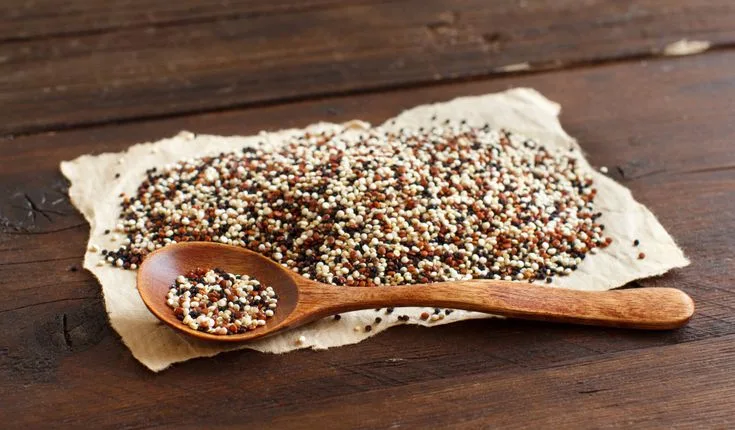
- Vegetarians and vegans — a reliable complete protein source without needing food combining.
- Athletes — leucine content (697mg/100g raw) directly supports muscle protein synthesis and recovery after training.
- Children and pregnant women — lysine is essential for growth and cell repair. Folate (19% DV per cup) is critical during pregnancy for neural tube development.
- People with celiac disease or gluten sensitivity — naturally gluten-free and far more nutritious than most gluten-free grain alternatives.
- Individuals managing blood sugar or diabetes — low GI (53) combined with protein and fibre produces a significantly blunted glucose response compared to rice or bread.
Frequently Asked Questions
Is quinoa good for weight loss?
Quinoa supports weight management through satiety, its protein and fibre combination keeps you fuller for longer and prevents the blood sugar crashes that trigger cravings.
However, it is not a low-calorie food at 222 calories per cooked cup.
No single food causes weight loss on its own. Quinoa works best as part of a calorie-managed diet where it replaces less filling, higher-GI foods like white rice or refined carbohydrates.
Can diabetics eat quinoa?
Yes — quinoa is one of the better carbohydrate options for people managing Type 2 diabetes or prediabetes. Its GI of 53 places it in the low-GI category, and its protein (8g) and fibre (5g) per cup further slow glucose absorption.
Research supports meaningfully reduced postprandial blood glucose peaks when quinoa replaces rice.
Portion control still matters — consult your doctor or dietitian for personalised guidance.
Is quinoa better than rice?
Quinoa is nutritionally superior to white rice in almost every measurable category, higher protein, more fibre, lower GI, richer in minerals and vitamins, and a complete protein versus rice’s incomplete protein.
Compared to brown rice, quinoa still wins on protein completeness and GI, though brown rice has more fibre per gram.
That said, rice is cheaper, more familiar, and pairs with a wider range of dishes. Both have a place, quinoa is a valuable addition, not necessarily a full replacement.
Is quinoa good for Indians? Does it suit Indian cooking?
Yes — quinoa adapts well to Indian cooking.
It can replace rice in khichdi, pulao, and biryani-style dishes, and replaces semolina in upma. It works in idli and dosa batter ground with urad dal. Its mild flavour absorbs Indian spices readily.
Given India’s large vegetarian population and rice-heavy diets, quinoa’s complete protein and lower GI make it a particularly practical addition to Indian meal patterns.
Does quinoa have gluten?
No — quinoa is naturally and completely gluten-free. It is botanically unrelated to wheat, barley, and rye.
However, people with celiac disease should buy specifically certified gluten-free quinoa, as some processing facilities handle multiple grains and cross-contamination is possible.
Naturally gluten-free does not automatically mean processed in a dedicated gluten-free facility.
How much quinoa should I eat per day?
A typical serving is half to one cup cooked (92–185g), providing 111–222 calories and 4–8g protein. For most healthy adults, one cup per day as part of a balanced diet is appropriate.
There is no established upper limit, but people with kidney stone history should moderate intake due to quinoa’s moderate oxalate content.
Athletes or those on high-protein plant-based diets can eat larger amounts without concern.
Why does my quinoa taste bitter?
Bitterness comes from saponins, the natural coating on quinoa seeds the plant evolved as insect protection.
The fix is simple: rinse quinoa in a fine-mesh sieve under cold running water for 60–90 seconds, agitating with your fingers, until the water runs completely clear.
Even pre-rinsed commercial quinoa benefits from this step. Once you do this consistently, bitterness is never an issue.
Is quinoa a complete protein?
Yes — quinoa is one of the very few plant foods that qualifies as a complete protein.
It contains all nine essential amino acids in meaningful quantities, including lysine, which is most commonly deficient in plant-based diets.
Its PDCAAS score of 0.76–0.94 is the highest of any commonly eaten plant food, though it does not quite reach the 1.0 score of egg white or casein.
Is quinoa better than millets?
Not across every measure. Quinoa wins on complete protein and low GI. But ragi (finger millet) has roughly 7× more calcium than quinoa. Bajra (pearl millet) has nearly double the iron.
Foxtail and kodo millets have higher fibre.
Indian millets are also significantly cheaper and more locally available across South Asia. The best approach is to use both, quinoa for its protein completeness, millets for their specific micronutrient strengths.
Can I eat quinoa every day?
Yes, for most people daily quinoa consumption is safe and nutritionally beneficial. It provides consistent protein, fibre, and micronutrient support as part of a varied diet.
The main caveats are for people with kidney stone history (moderate oxalates) and those with sensitive digestive systems who should introduce it gradually.
Rotating quinoa with other grains and millets gives you a broader nutritional profile overall.
All nutritional values sourced from USDA FoodData Central. Figures represent averages — actual content varies slightly by variety, growing conditions, and preparation method. This article is for informational purposes. Consult a registered dietitian for personalised dietary advice.