

Makhana — also known as fox nut, phool makhana, lotus seed, or gorgon nut — has moved from a traditional fasting food to one of India’s fastest-growing healthy snack categories. It is gluten-free, low in calories, high in protein, and naturally additive-free, making it a favourite among health-conscious consumers, gym-goers, and clean-label food brands worldwide.
But not all makhana is the same. Walk into any wholesale market in Bihar and you will quickly discover that makhana comes in multiple grades, forms, and cultivation types — each suited to a different use.
According to IMARC Group, India’s makhana market was valued at approximately ₹9.29 billion in 2025 and is projected to grow at 8.85% CAGR through 2034. The Indian government has also established a dedicated Makhana Board to promote and regulate the industry.
If you are a consumer, retailer, food brand, or bulk buyer trying to understand which type of makhana is right for your needs, this guide covers everything — grades, forms, flavours, regional varieties, quality checks, storage, and a clear decision framework.
Makhana grades – the Suta system explained
The most important thing to understand about makhana is the Suta grading system. Suta is the unit of measurement used to classify makhana by size. One Suta equals approximately 3.17mm — so a higher Suta number means a larger, rarer, and more valuable makhana.
Larger makhana puffs are rarer in any harvest batch, which is why premium grades command significantly higher prices. Here is the complete Suta grade breakdown:
| Grade | Size (mm) | Category | Best For | Price Level |
|---|---|---|---|---|
| 4 Suta | 12–15 mm | Regular | Cooking, kheer, curries, bulk food processing | Most affordable |
| 5 Suta | 15–18 mm | Good | Everyday snacking, branded retail packs | Mid-range |
| 6 Suta | 18–21 mm | Premium | Premium retail, gifting, gourmet dishes | High |
| 7 Suta | >21 mm | Super Premium | Export markets, luxury retail, high-value gifting | Highest |
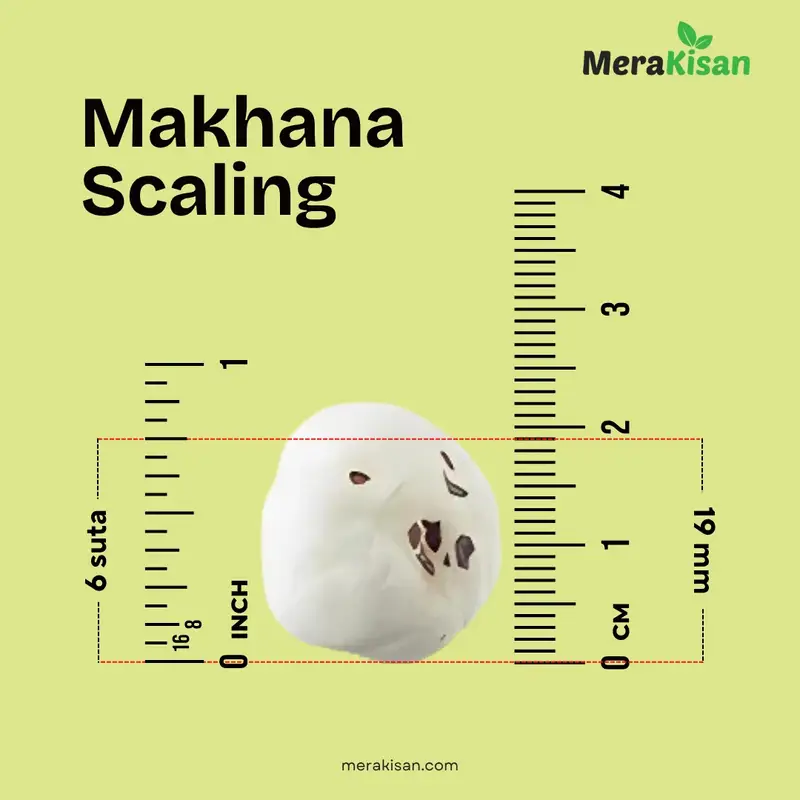
A note on the Lava system: Some Bihar traders also use the Lava classification — Lava 2 (12–16mm), Lava 3 (16–20mm), and Lava 4 (20–28mm). This is a regional alternative framework that broadly aligns with the Suta system. For B2B buyers and international trade, the Suta system is the standard.
Types of makhana by form

Beyond grade, makhana is available in three primary forms — raw, roasted, and flavoured. Each serves a different purpose.
Raw makhana (phool makhana)
Raw makhana is the unprocessed, popped lotus seed in its natural form. It is white, light, and has a mild, neutral flavour. This is the base form from which roasted and flavoured makhana is made.
Raw makhana is ideal for home cooking — it can be added to kheer, curries, halwa, raita, and other traditional dishes. It is also the preferred form for food manufacturers, processors, and B2B buyers who want to roast and season it under their own brand. Raw makhana has a shelf life of 9–12 months when stored correctly.
Best for: Traditional cooking, food processing, B2B wholesale, export, private label manufacturing
Roasted makhana
Roasted makhana is raw makhana that has been dry-roasted or lightly roasted in ghee or oil. It is crunchier, more aromatic, and ready to eat straight from the pack. This is the most popular form for everyday healthy snacking.
Roasted makhana retains most of the nutritional benefits of raw makhana — it is still low in calories, high in protein, and free from artificial additives when produced cleanly. For retail brands and health food businesses, roasted makhana is the starting point for flavoured product development.
Best for: Everyday snacking, gym nutrition, weight management, retail health food brands
Flavoured makhana
Flavoured makhana is roasted makhana seasoned with spices, herbs, or sweet coatings. This is the fastest-growing segment of the makhana market, driven by consumer demand for healthy snacks that do not compromise on taste.
At MeraKisan, we manufacture 25+ flavoured makhana variants for retail brands, private label programs, and international export. Our flavour range covers every snacking occasion:
Classic & everyday flavours:
- Himalayan Salted Makhana
- Black Pepper & Salt Makhana
- Cream & Onion Makhana
- Tangy Tomato Makhana
- Mint (Pudina) Makhana
Spicy & bold flavours:
- Peri Peri Makhana
- Lemon Chilli Makhana
- Ginger Makhana
- Momo Chutney Makhana
International fusion flavours:
- Wasabi Makhana
- Kimchi Makhana
- Gochujang Makhana
- Spicy Miso Makhana
- Thai Sweet Chilli Makhana
- Dill Pickle Makhana
- Buffalo Ranch Makhana
Premium & gourmet flavours:
- Truffle Parmesan Cheese Makhana
- Caramel Salted Makhana
- Chocolate Makhana
- Peanut Butter Makhana
- White Cheddar Makhana
Custom flavour development is available for brands with specific regional or international requirements.
Best for: Retail snacking, private label brands, gifting, export to international markets, food service
Makhana by region — where it is grown
India produces over 90% of the world’s makhana supply, almost entirely from the state of Bihar. Within Bihar, two regions are particularly notable:
Mithila makhana
Mithila makhana originates from the Mithila region of Bihar — covering districts like Darbhanga, Madhubani, Sitamarhi, and Saharsa. This is the most prized makhana in the world and holds a Geographical Indication (GI) tag, which legally protects its origin the same way Darjeeling tea and Basmati rice are protected.
GI-tagged Mithila makhana is recognised for its superior size, uniform texture, bright white colour, and clean snap. For export markets and premium retail, GI-tagged makhana commands the highest prices and is the only variety accepted by buyers in regulated markets like the EU, USA, and UK.
MeraKisan sources exclusively from GI-tagged Mithila farms, directly from farmer networks in Katihar and surrounding districts.
Purnia makhana
Purnia district in northeastern Bihar is another significant makhana cultivation zone. Purnia makhana is recognised for its consistent quality and reliable supply and is widely used in domestic wholesale and processing markets. While it does not carry the GI tag, it is a quality product used widely by processors and distributors across India.
How makhana is cultivated
Understanding cultivation helps buyers assess quality and make sourcing decisions.
Organic cultivation
Organically cultivated makhana is grown without synthetic fertilisers, pesticides, or chemical inputs. It is certified under NOP (National Organic Program) or NPOP (National Programme for Organic Production) standards. Organic makhana commands a significant price premium in export markets — particularly in the USA, EU, and UK — and is increasingly in demand by clean-label food brands.
MeraKisan holds NOP and NPOP organic certification and can supply organic-certified makhana for export orders.
Conventional cultivation
Conventional makhana follows traditional practices using natural pond ecosystems in Bihar’s Mithila region. It is grown in shallow ponds and waterlogged fields, hand-harvested by the Mallah farming community who have cultivated makhana for generations. While conventional makhana is not organically certified, it is naturally grown with minimal external inputs due to the nature of pond cultivation.
Both organic and conventional makhana produced in the Mithila region can carry the GI tag, as the designation is based on geography and method rather than organic certification alone.
How to identify quality makhana
Whether you are buying for retail consumption or B2B sourcing, these are the quality markers that distinguish premium makhana from inferior batches:
Colour: High-quality makhana is uniformly bright white. Yellowing, beige tones, or grey patches indicate age, moisture exposure, or improper storage.
Size uniformity: Premium grades are sorted and graded for consistent size within the pack. A bag with mixed sizes suggests poor grading and lower quality processing.
The snap test: Fresh, well-dried makhana produces a clean, crisp snap when broken. Soft, chewy, or bendy makhana indicates high moisture content and will not store well.
Black spots: A small number of natural black spots are normal and do not affect quality. Excessive spotting or dark patches across the surface suggests fungal issues or poor harvest conditions.
Smell: Fresh makhana has a neutral, slightly earthy smell. Any musty, sour, or off-putting odour indicates moisture damage or improper storage.
How to store makhana correctly
Proper storage is essential for maintaining makhana’s crunch, flavour, and shelf life.
- Store in an airtight container — exposure to air causes makhana to absorb moisture and lose its crunch within days
- Keep in a cool, dry place away from direct sunlight and heat sources
- Do not refrigerate raw or roasted makhana — the moisture inside a refrigerator causes rapid softening
- Flavoured makhana should be consumed within the timeframe on the packaging, typically 3–6 months
- Raw makhana stored correctly has a shelf life of 9–12 months
- For bulk storage, use food-grade sealed sacks in a climate-controlled warehouse away from moisture
Which type of makhana should you choose?
This is the question the post title promised to answer — here is the practical decision guide:
| Your Situation | Recommended Grade | Recommended Form |
|---|---|---|
| Home cooking (kheer, curry, halwa) | 4 Suta or 5 Suta | Raw |
| Everyday healthy snacking | 5 Suta | Roasted or flavoured |
| Retail brand or private label | 5 Suta or 6 Suta | Flavoured (custom) |
| Premium retail or gifting | 6 Suta or 7 Suta | Roasted or flavoured |
| B2B wholesale (domestic India) | 4 Suta or 5 Suta | Raw |
| Export to USA / UK / EU | 6 Suta or 7 Suta | Raw or flavoured |
| Food processing or ingredient use | 4 Suta | Raw |
| Organic certified markets | Any grade | Raw (NOP/NPOP certified) |
Sourcing makhana in bulk or for export?
MeraKisan is an APEDA-registered makhana exporter based in Katihar, Bihar, supplying GI-tagged Mithila Makhana in all four Suta grades to B2B buyers worldwide. We supply raw, roasted, and 25+ flavoured variants with full export documentation, private label options, and free samples for qualifying buyers.
Certifications: FSSAI · APEDA · HACCP · Halal · USDA · ISO · GI-Tag · NOP/NPOP
Conclusion
Makhana is not a single product it is a category with meaningful variation in grade, form, flavour, cultivation method, and regional origin. Choosing the right type starts with knowing your use case: cooking at home, everyday snacking, building a retail brand, or sourcing in bulk for export.
The Suta grading system is your foundation. GI-tagged Mithila origin is your quality assurance. And whether you need raw makhana for your kitchen or 6 Suta export-grade supply for your international brand, the principles are the same — source from a verified Bihar supplier with traceable, certified makhana.